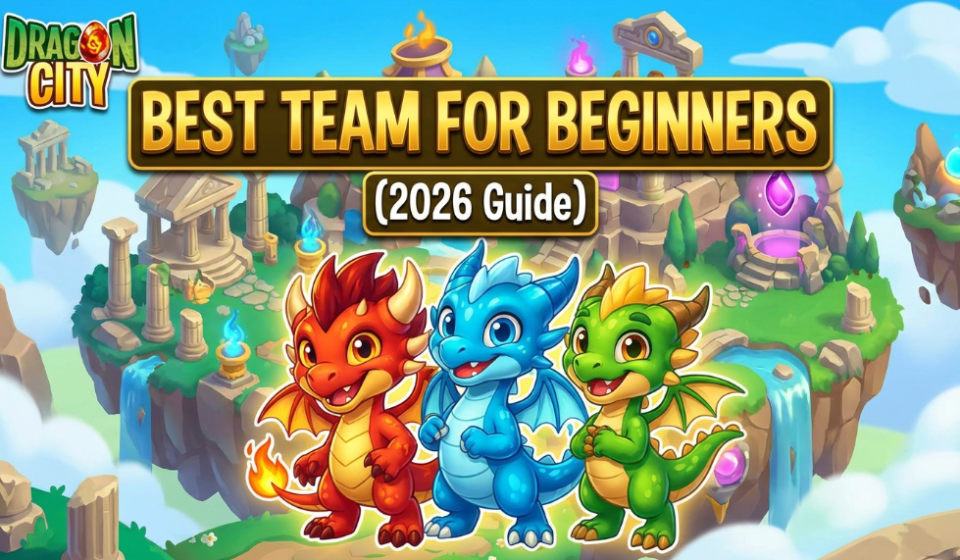

When I first started Dragon City, I did what most new players do: I kept every single dragon I bred, named them all, got emotionally attached, and then wondered why I kept losing battles against players who seemed to have way fewer dragons than me but steamrolled every fight.
The answer, I eventually figured out, had nothing to do with how many dragons I owned. It was about which three dragons I was putting in my combat team — and whether those three actually worked together.
Dragon City looks like a city-builder on the surface, but once you start getting into Dragon League battles and PvP, it becomes a surprisingly strategic game. The right team composition makes an enormous difference, especially in the early and mid-game where most players are figuring things out.
This guide is built around what actually works for new players in 2026 — not the most expensive legendaries, not the dragons you’d get after six months of grinding, but the team you can realistically build in your first few weeks that will carry you through early content and set you up well for what comes next.
Before We Get Into Specific Dragons: Understand the Element System
Dragon City’s battle system runs on elemental strengths and weaknesses. Every dragon has one or more elements, and those elements determine what attacks they’re strong against — and what they’re vulnerable to.
Here’s the basic flow that matters most early on:
- Fire is strong against Nature and Ice
- Water is strong against Fire and Earth
- Nature is strong against Water and Electric
- Electric is strong against Water and Metal
- Ice is strong against Nature and Electric
- Earth is strong against Electric
- Metal is strong against Ice and Earth
- Dark and Light counter each other
The reason this matters for team-building: if all three of your dragons share the same element, a single opponent with the right counter can wipe your entire team. A beginner team should cover at least 2–3 different elements so you’re not one-dimensional.
This is mistake #1 that most new players make — stacking all their favorite-looking dragons without checking whether those dragons cover different weaknesses.
The Core Principle: Coverage Over Power
Before I give you specific dragons, here’s the mindset shift that changed how I played:
A level 15 team with good elemental coverage will beat a level 20 team with poor coverage almost every time.
Early in the game, you don’t have access to the legendary dragons that dominate top-tier play. That’s fine. The goal isn’t to out-power everyone — it’s to build a team that can adapt to different opponents and not get swept by a single counter.
Three dragons. Different elements. Decent levels. That’s the foundation.
The Best Early Team: What to Actually Build
Here’s the team composition I’d recommend for most beginners, with the reasoning behind each slot.
Slot 1 — Cool Fire Dragon (Fire + Ice)
If there’s one dragon that comes up in every beginner guide for a reason, it’s the Cool Fire Dragon.
This is a dual-element hybrid — Fire and Ice — and that combination is excellent because it covers two different attack types. It also learns some of the better early-game moves available to non-legendary dragons.
How to breed it: Flame Dragon + Ice Dragon. Both of those are accessible early in the game. The breed isn’t guaranteed (you might get other combinations first), but it’s worth attempting repeatedly until you get it.
The Cool Fire Dragon’s real value is versatility. It can threaten Nature dragons with Fire moves and hit Electric and Nature types with Ice. It’s not flashy, but it’s reliable — and reliability matters more than flashiness when you’re still learning.
Level target: Get this one to at least level 15 before PvP battles.
Slot 2 — Soccer Dragon (Electric + Fire + Water)
The Soccer Dragon is a triple-element dragon, which makes it one of the most versatile options available to early-game players. Triple elements mean more move variety and harder-to-counter type coverage.
It’s also one of the more consistently available dragons through in-game events, and it shows up in the regular breeding options too (though breeding for specific results varies).
What makes Soccer good: three elements mean your opponent can’t simply bring in one counter and shut it down. They’d need to cover Fire, Electric, and Water vulnerabilities simultaneously — which is much harder to do with a standard battle team.
If you can’t get Soccer Dragon early, Gummy Dragon (Electric + Water + Fire) covers similar ground and is bred from accessible parents.
Slot 3 — A Strong Single-Element Dragon for Your Weak Spots
This slot depends on what gaps your first two dragons leave. Think of it as your insurance policy.
If your first two dragons are light on Water coverage, slot 3 should cover it. If you’re weak to Dark element attacks, consider a Light or War element dragon here.
For most beginners, a solid Medieval Dragon (War + Dark) or a leveled-up Terra Dragon (Earth) works well in this slot because they cover elements that don’t naturally appear on most starter hybrid dragons.
The Terra Dragon is actually your default starting dragon — don’t dismiss it. At higher levels with good moves equipped, it’s more useful than most players give it credit for.
What About Legendary Dragons?
Yes, legendaries are the best dragons in the game. Pure Light, Durian, High Overlord, and similar top-tier legendaries dominate endgame PvP.
No, you shouldn’t be building your strategy around them as a beginner.
Here’s why: legendary dragons require either spending gems (the premium currency), completing specific long-term event tasks, or getting lucky with breeding combinations that have very low success rates. Spending your early resources chasing legendaries instead of leveling a solid accessible team is one of the most common mistakes I see new players make.
Build the best team you can with what you have. Level those dragons properly. Learn how battles actually work. By the time you’ve done that, you’ll have a much better understanding of which legendary dragons actually suit your playstyle — and you’ll have the resources to pursue them more efficiently.
Leveling: The Part Most Beginners Get Wrong
Having the right dragons is half the equation. Leveling is the other half — and there’s a right and wrong way to approach it.
Wrong: Spreading food evenly across all your dragons to keep them at similar levels.
Right: Picking your 3–4 core battle dragons and focusing food almost entirely on those until they’re strong.
Food is your most limited resource early in Dragon City. Your farms produce it slowly, and leveling costs scale up quickly. If you’re feeding 12 dragons at level 5 instead of 3 dragons at level 15, you’ll always feel like you don’t have enough food — and your battle team will always feel underpowered.
Choose your team. Commit to it. Level them up.
Move Selection Matters More Than Most Guides Mention
Each dragon has four move slots, and you pick two moves to use in battle. This sounds simple but it’s where a lot of beginners leave wins on the table.
Always equip moves that match your dragon’s elements. A Fire dragon dealing Fire damage gets an elemental bonus. A Fire dragon using a Water move doesn’t. Seems obvious, but I spent a solid two weeks using off-element moves because I just picked whatever looked like it had the highest damage number.
Prioritize moves with high power AND the correct element. When you’re given the option to train new moves, look at:
- Element match (does it match one of the dragon’s elements?)
- Power rating (higher is better, all else equal)
- Cooldown (some powerful moves have multi-round cooldowns — fine for PvP, can be awkward in timed content)
Building Around Events
One thing that changes in 2026 compared to older guides: Dragon City runs frequent limited-time events that offer strong dragons as prizes — often stronger than what you’d typically be able to breed or buy at the same stage of the game.
Pay attention to these events. Some of them offer genuinely excellent battle dragons as top rewards, and even mid-tier event rewards are often competitive.
The Dragon League specifically gets more accessible the further you get into the game, and event dragons often have unique dual or triple element combinations that you couldn’t breed in the standard hatchery.
Common Beginner Mistakes (That I Made, So You Don’t Have To)
Keeping too many dragons at low levels. Your food has to go somewhere. Put it where it counts.
Ignoring the weakness chart. Going into PvP without understanding what your dragons are vulnerable to is like going into a rock-paper-scissors tournament without knowing the rules. Spend 10 minutes learning the basic element matchups.
Using gems to rush breeding timers. Gems are precious early on. Don’t spend them on impatience. Save them for habitat upgrades, which increase your gold income, or for specific event dragons.
Building a team of three dragons from the same element. Covered this above, but worth repeating — it’s the fastest way to get swept by a single opponent.
Neglecting your farms. Food is the bottleneck for leveling. The more farms you have running, the faster your team grows. Expand farm capacity as early as you can.
The Bare-Bones Starter Checklist
If you want a simple action list to take away from this:
- [ ] Breed a Cool Fire Dragon (Flame + Ice) — attempt repeatedly until successful
- [ ] Get or work toward a triple-element dragon like Soccer or Gummy
- [ ] Pick a third dragon that covers your gaps (Terra works fine to start)
- [ ] Focus all food resources on these three until they hit level 15+
- [ ] Equip moves that match each dragon’s elements
- [ ] Learn the 8–10 basic elemental matchups before doing ranked PvP
- [ ] Save gems — don’t rush timers
A Note on Team Updates
Dragon City adds new dragons and occasionally rebalances content, so any “best team” list has a shelf life. What I’d emphasize more than any specific dragon recommendation is the principle: coverage, levels, and correct move selection beat raw stats almost every time at the beginner stage.
Once you’re comfortable with those fundamentals, you can start looking at the tier lists for current-season legendaries and building toward the top-end endgame teams. But none of that matters if the basics aren’t solid first.
Get the Cool Fire Dragon. Level your team. Learn the matchups. Everything else follows from there.
Playing something different from what’s here, or found a combo that’s working well for you? Drop it in the comments — always curious what’s clicking for other players.